

Amid West Asia war, US and Indonesia strike trade deal
Indonesia seeks US investments in its mineral industry and agrees to purchase American energy
Amid West Asia war, US and Indonesia strike trade deal
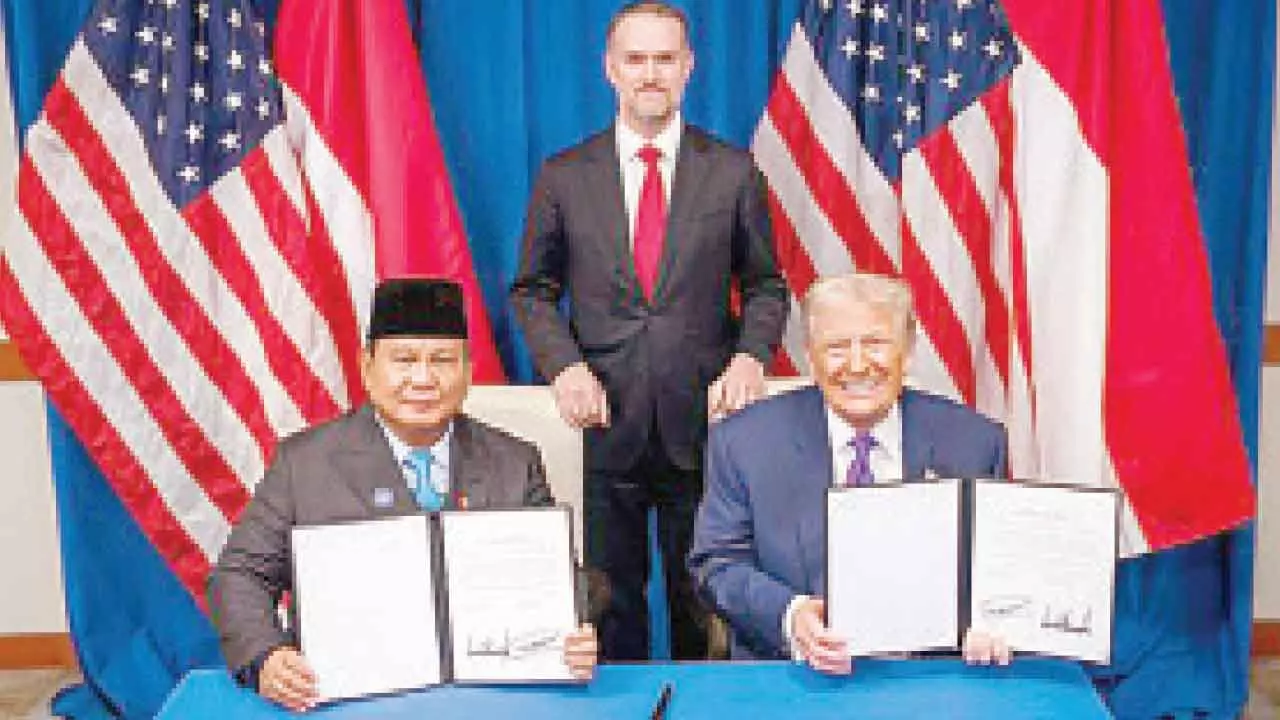
A new trade pact between Indonesia and the United States has recast their economic ties, binding Jakarta's resource wealth and energy future more closely to Washington's strategic needs.
Indonesia agreed to widen access for US investors in critical minerals, boost its purchases of US crude and liquefied petroleum gas, back the development of an American coal export corridor and cooperate on small modular nuclear reactors.
In turn, the US trimmed a threatened 32 per cent tariff on Indonesian goods to 19 per cent and granted broader access to the American market, including a zero-tariff entry policy for major products such as palm oil, coffee, cocoa, spices and rubber.
Though the US Supreme Court's ruling against President Donald Trump's tariffs may impact how it is implemented. The deal fits with longer-term US efforts to secure critical mineral supply chains, beef up its oil and gas exports and reduce dependence on China.
Meanwhile, other export-reliant Southeast Asian economies negotiating with the United States, including Vietnam, are closely watching the Indonesia–US trade deal for clues about the tariff levels and concessions Washington may demand across the region.
Indonesia, the world's largest nickel producer, has vast mineral reserves needed for electric vehicles and clean energy systems. It's caught between the conflicting aims of the US and China, a key source of foreign investment and market for Indonesian coal and nickel, analysts say.
China is concentrating on electrification, renewables and dominance of battery supply chains, while the US is pairing its push for mineral access with more fossil fuel exports.
Haryo Limanseto of Indonesia's Coordinating Ministry for Economic Affairs said the deal's energy provisions “balance foreign trade and meet domestic energy needs.”
“The leadership of Indonesia is trying to tread a fine line between the West and China,” said Putra Adhiguna of the Jakarta-based Energy Shift Institute, adding that Chinese influence is “inescapable” since it is Indonesia's largest trading partner.
The US gains a new foothold in Indonesia's minerals
Indonesia has pledged to promote US investment across its mineral industry, from exploration and mining to refining, transport and export. In some cases, American investors will receive treatment “no less favourable” than domestic firms.
Restrictions on exports of critical minerals to the US will be relaxed to expedite development of Indonesia's rare earths and critical minerals sector with US partners, promising “greater certainty” for companies involved in extraction to help boost production, the agreement says.
Major policy shifts have altered Indonesia's mining sector in the past six months, and the trade deal's new restrictions on existing foreign-owned entities in Indonesia will curb excess output from processing plants. Foreign businesses must follow the same tax, environmental, labour, and quota rules as other companies.
Indonesia's critical mineral processing sector is currently dominated by China, which has firms operating or financing multiple nickel smelters and industrial parks.
“Indonesia is absolutely central to this competition because it combines resource endowment with political ambition,” said Kevin Zongzhe Li, with the Centre for China Analysis within the Asia Society Policy Institute, a New York-based think tank.
Competition over critical minerals is heating up, and the agreement “opens the door for US firms to have a real shot” at “modestly levelling a sector where Chinese industries established first mover advantage,” he said.
Indonesia to purchase more US energy
Indonesia has agreed to cut red tape so that its companies can more easily purchase US energy products. It plans to buy $ 15 billion worth of American energy commodities over an unspecified period, mainly fossil fuels such as liquefied petroleum gas, crude oil and gasoline.
Trump's efforts to persuade Asian countries to buy more American LNG have gained momentum during trade talks, with energy purchases emerging as a way to narrow trade gaps.





